
This website uses cookies so that we can provide you with the best user experience possible. Cookie information is stored in your browser and performs functions such as recognizing you when you return to our website and helping our team to understand which sections of the website you find most interesting and useful. Check our privacy policy here

CCR9
Chemokine receptor 9 (CCR9) is a G protein–coupled receptor involved in the regulation of immune cell trafficking, particularly directing lymphocyte homing to the intestinal tract through its interaction with the ligand CCL25. While its physiological expression is largely restricted to the thymus and small intestine, aberrant activation of the CCR9/CCL25 axis has been implicated in multiple pathological conditions.
In immune-mediated diseases such as inflammatory bowel disease (IBD), CCR9 drives the recruitment of pathogenic lymphocytes to inflamed intestinal tissues, contributing to chronic inflammation and fibrosis. In parallel, CCR9 is frequently overexpressed in both solid and hematologic malignancies, where it promotes tumor progression, metastatic dissemination, and resistance to therapy.
Together, these roles position CCR9 as a compelling therapeutic target across oncology and inflammatory diseases.
CCR9 Programs. Scientific Evidence
CCR9 IN IBD
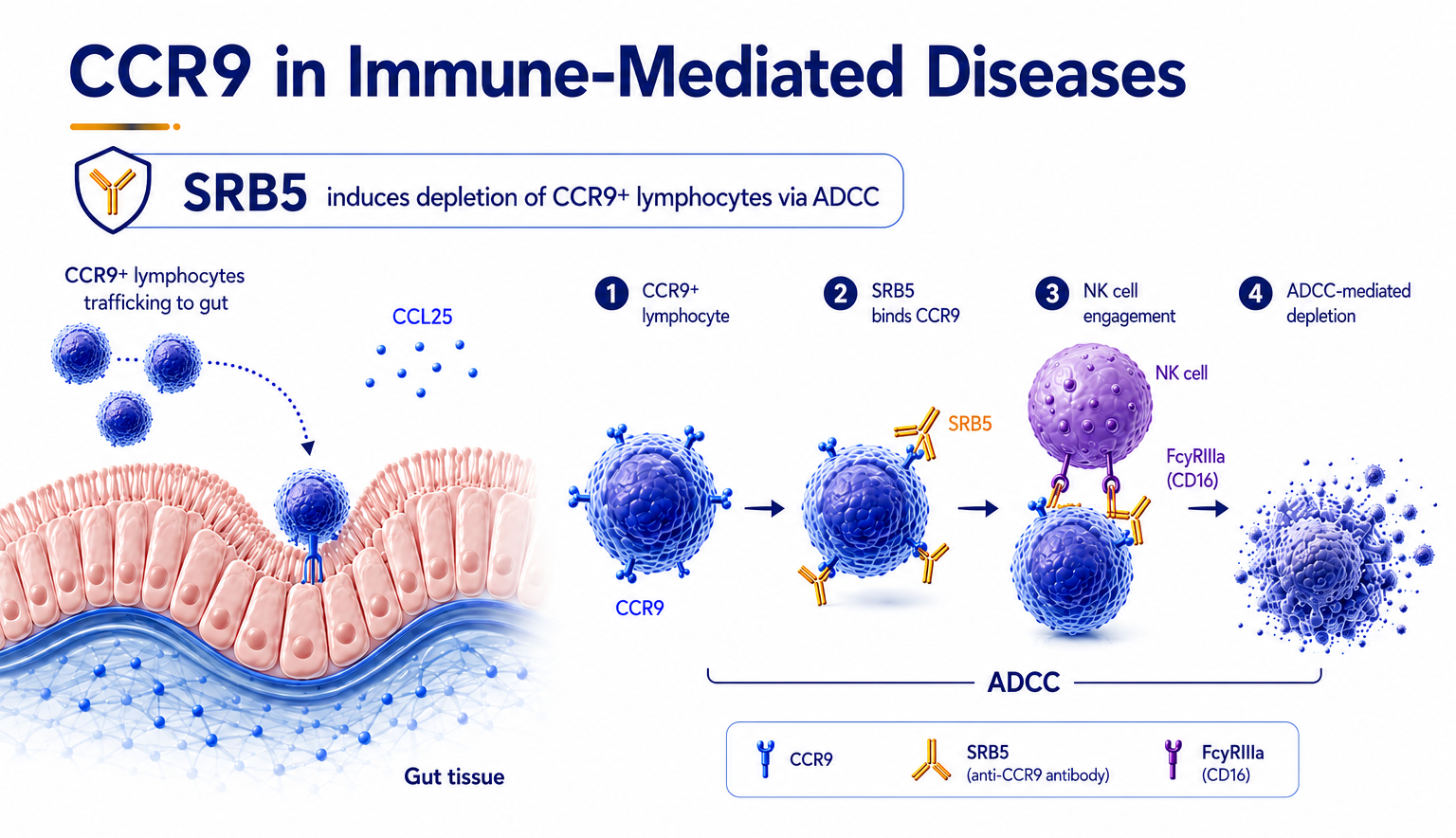
- CCR9 guides lymphocyte migration to the gut, making it a key regulator of intestinal immune trafficking.
- In IBD, dysregulation of the CCR9/CCL25 axis is associated with intestinal inflammation and disease activity.
- Increased CCR9⁺ T cells have been reported in patients with intestinal inflammation.
- SRB5 is designed to selectively deplete CCR9⁺ pathogenic T cells through ADCC, restoring immune balance in inflamed intestinal tissue.
CCR9 IN ONCOLOGY
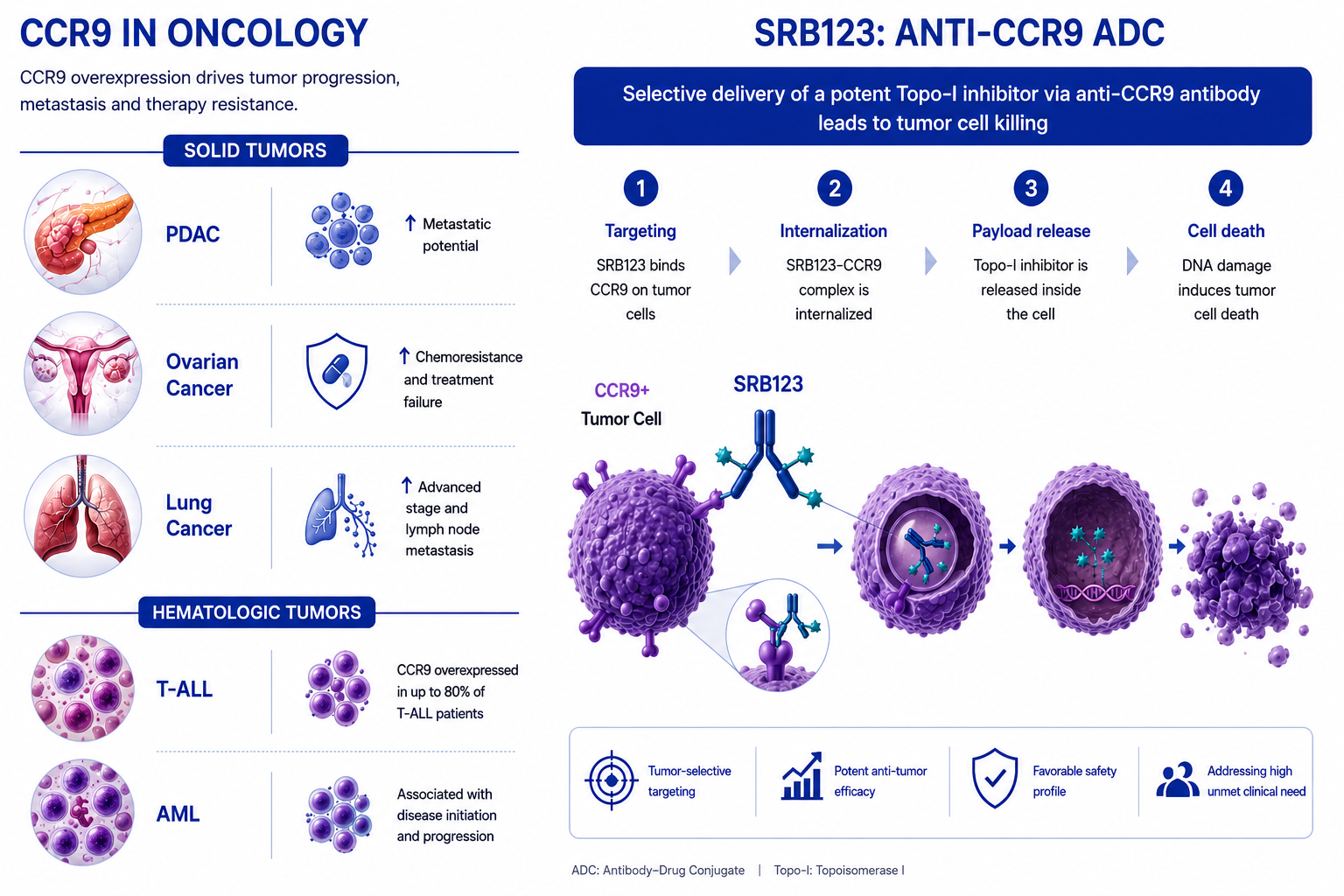
- CCR9 overexpression is linked to tumor progression, metastasis, and therapy resistance in solid tumors including PDAC, ovarian cancer, and lung cancer.
- In hematologic tumors, CCR9 is frequently overexpressed in T-ALL and AML, where it is associated with disease initiation and progression.
- SRB123 is designed to selectively deliver a potent cytotoxic payload to CCR9⁺ tumor cells, inducing targeted tumor cell killing while limiting exposure to CCR9-negative tissues.
Anti-CCR9 Therapeutic Antibodies
SunRock has developed an anti-CCR9 humanized antibody with increased Antibody-dependent cellular cytotoxicity (ADCC), SRB5, for the depletion of CCR9+ T cells in the context of IBD. Efficacy has been proven in vitro, in vivo and ex vivo in intestinal biopsies from IBD patients.
SunRock has also developed SRB123, a first-in-class anti-CCR9 antibody-drug conjugate (ADC) designed to selectively target and eliminate CCR9⁺ tumor cells. Conjugated to a next-generation topoisomerase I inhibitor payload, SRB123 has demonstrated potent and selective cytotoxic activity in vitro and robust antitumor efficacy in vivo across multiple preclinical cancer models.
SunRock Biopharma owns exclusive, world-wide rights of the IP protecting the CCR9-targeted antibodies.
SunRock’s lead asset, SRB5, is a best-in-class anti-CCR9 antibody that shows a MoA based on ADCC and demonstrated depletion of circulating and intestinal CCR9 expressing T cells both in vivo and ex vivo in patient samples
SRB5 showed ex vivo efficacy in intestinal explants from IBD patients
- SRB5 treatment specifically reduces the percentage of CCR9⁺ T lymphocyte subsets in peripheral blood, without affecting the overall number of circulating T lymphocytes
- SRB5 demonstrates therapeutic efficacy in IBD patients regardless of clinical history, showing positive outcomes even in those naïve, or even treated with mesalazine, infliximab, Ustekinumab or JAK inhibitors.
- SRB5-mediated depletion of CD4+ CCR9+ T cells is associated with a significant reduction in the soluble levels of the main proinflammatory cytokines
SRB5 showed improved binding, ADCC activity and efficacy compared to benchmark anti-CCR9 antibody
- SRB5 shows a 16-fold higher CCR9+ T cell-depleting activity compared with benchmark anti-CCR9 antibody
- SRB5 display sub-nanomolar binding, achieving markedly higher target occupancy than benchmark anti-CCR9 antibody
- In patient-derived assays, SRB5 shows greater efficacy than benchmark anti-CCR9 antibody in depleting CCR9⁺ CD4⁺ T cells both in intestinal explants and in peripheral blood
- No toxicity symptoms in any of the animal models tested
SunRock is co-developing SRB123, with Escugen Biotechnology. SRB123 is a first-in-class CCR9 targeting ADC with optimized efficacy and safety
Escugen’s EZWi-Fit® Technology Platform employs stable-cleavable linkers and an innovative Topoisomerase I inhibitor payload, showing outstanding antitumor efficacy and safety profile supporting its best-in-class potential
SRB123 favorable safety profile in mice at both DAR4 and DAR8
- A repeat-dose toxicity study in huCCR9 knock-in mice showed that SRB123 DAR4 and DAR8 were well tolerated.
- No clinical signs of toxicity were observed, and body weight remained stable and comparable to vehicle-treated animals.
SRB123 efficacy in Ovarian and Pancreatic PDX Models
- SRB123 induced complete tumor regression in a highly aggressive HGSOC PDX model derived from ascitic-fluid organoids from a patient with stage IVB disease who was refractory to carboplatin/paclitaxel and rapidly progressed.
- In pancreatic cancer PDX models, SRB123 achieved tumor stasis in a multidrug-resistant model refractory to gemcitabine/Abraxane, and tumor regression in a second model, showing clear superiority over gemcitabine/Abraxane.
Anti-CCR9 Pipeline
SRB5
Discovery
Preclinical
Clinic phases
SRB123
Discovery
Preclinical
Clinic phases